Manchester State Park was laid out around a minefield. The brick building State Parks now rents out for weddings and parties held the mines. The small concrete building beside it held the switches that set them off. The gun battery nearby was there to protect both buildings. After the reservation season ends on Oct. 31, the warehouse at the center of all this stops being something you book and becomes first-come, first-served.
The three structures were built around 1900 to work as one system. All three are still standing, and you can walk through it on a gray November morning without a reservation.
Three buildings, one machine
Washington State Parks says the military reservation at Middle Point was set up in 1899 to help defend Puget Sound. Its "chief mission" was to operate a minefield in Rich Passage. The three surviving structures each had a job in that mission, and the park brochure says all three are listed on the National Register of Historic Places.
| Structure | Its original job | What it is now |
|---|---|---|
| Torpedo Warehouse | Stored the underwater mines, called "torpedoes" at the time, along with mine cases, anchors and other equipment | Group day-use picnic shelter and event space for 20 to 150 guests |
| Mining casemate | Housed the generator, storage battery and electric controls for the mines | Historic structure next to the warehouse |
| Battery Mitchell | Built to defend the buildings, designed around 3-inch rapid-fire guns | Historic structure; the guns were never delivered |
State Parks gives two dates for the warehouse. Its history of the park says the brick building was completed in 1900. The agency's Torpedo Warehouse page says 1901 and adds that the building later served as an officers' club, barracks and mess hall. Either way, it went up at the turn of the century, and it has had more lives than its current role suggests.
Why the casemate is the most interesting building in the park
The casemate is the smallest of the three structures, and it explains how the whole system worked.
The State Parks history describes what was packed inside. There was a kerosene-powered generator and an 80-volt direct-current storage battery made of 40 glass or rubber boxes filled with sulfuric acid and wired in series. There were also the electric controls for 19 mines hung from cables in Rich Passage.
The wiring mattered because these were not contact mines. Contact mines explode when something bumps them, so an attacker could send empty boats through first to set them off and clear a path. The Rich Passage mines were set off by command from shore, so a decoy boat could drift over them and nothing would happen until the operators chose a target. The casemate was the trigger for the whole minefield.
That also explains why the battery was built at all. Battery Mitchell was put up to defend the buildings, not to fire on ships out in the main channel, and according to the history, no guns were ever installed. The brochure says the same about the 3-inch rapid-fire rifles it was designed around.
Why Rich Passage, and why it ended so quickly
The location follows from the target. The three forts at the entrance to Admiralty Inlet were Puget Sound's main defense. Middle Point, along with Beans Point across the water on Bainbridge Island, was acquired as a last line of defense for the Naval Shipyard at Bremerton. Any warship trying to reach the yard through Rich Passage had to cross a minefield wired back to a small concrete room in what is now a campground.
That arrangement was short-lived. According to State Parks, Middle Point's coast defense role ended in 1910, when mine operations moved across Rich Passage to Fort Ward on Bainbridge Island. That gave it about a decade of active duty. The brochure says the Navy kept operating Middle Point until it was decommissioned in 1958.
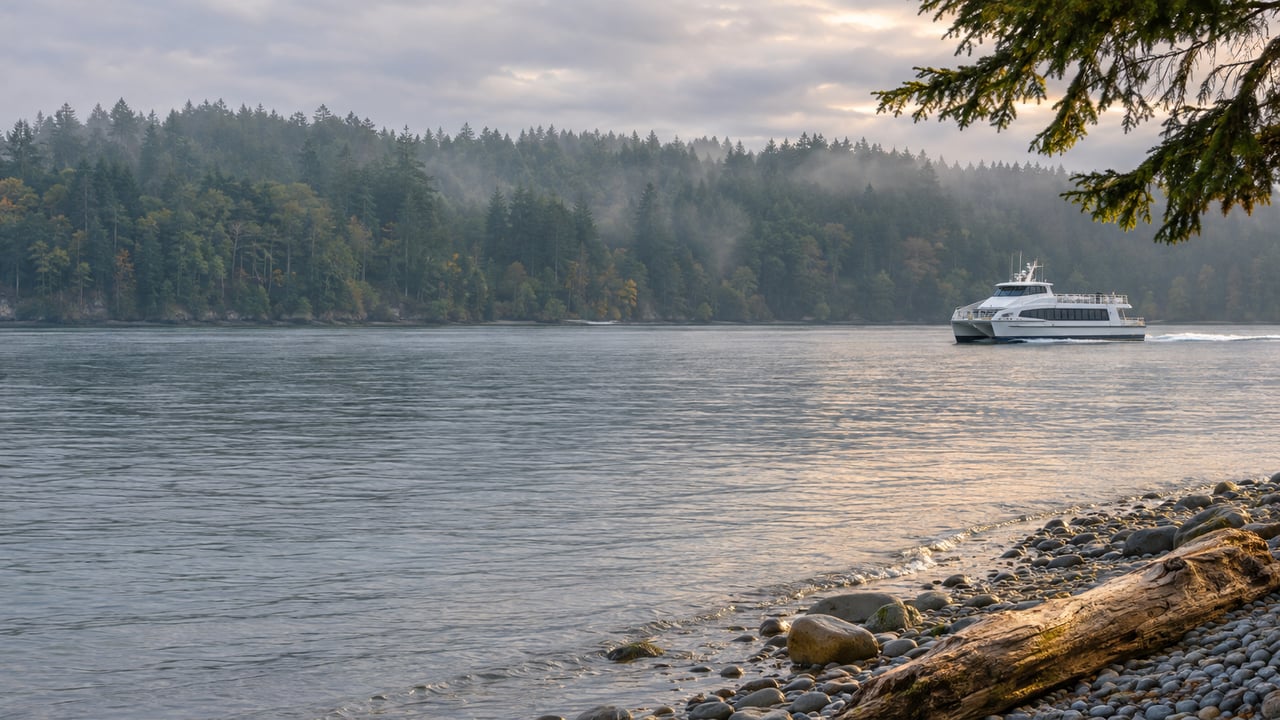
The ground under the buildings is unusual too. The history notes that the solid bedrock exposed at Middle Point is rare on the Puget Sound shoreline. It is found only at Rich Passage and a few spots on the western shore of Hood Canal, while most bedrock in the region is buried under glacial debris. When you stand on the rocky beach and look toward Bainbridge, you are looking across the same water the minefield was built to close off.
Before the Army, and after it
The minefield is one short chapter in a much longer history of this shoreline. The park sits within the traditional territories of Coast Salish peoples, whose present-day descendants include members of the Suquamish Tribe. Clam Bay, just south of Middle Point, was recorded in the original government survey as a "very large bed of fine clams," and Indigenous residents had long tended it. The State Parks history says the tribes ceded the area to the federal government under duress in the Treaty of Point Elliott in 1855 and kept their rights to harvest in their usual and accustomed places.
Private owners came next. George A. Meigs, owner of the Port Madison lumber mill on Bainbridge Island, bought seven acres of Middle Point's rocky shore. The land under today's campground loops was granted to the State of Washington at statehood in 1889.
Turning it into a park took a long time:
- 1928: The shore at Middle Point is first sought as a park site.
- 1962: Negotiations to buy the property begin.
- 1964: Voters approve Initiative 215, which funds the purchase.
- 1970: The Washington State Parks and Recreation Commission buys the land from the federal General Services Administration.
- July 18, 1981: Manchester State Park is dedicated.
That is 53 years from the first proposal to the ribbon. The Navy still occupies the part of the Middle Point Military Reservation that never went to State Parks.
What changes after Oct. 31
The Manchester State Park page says the Torpedo Warehouse and picnic shelters can be reserved from April 1 through Oct. 31. Outside that window, the day-use facilities are first-come, first-served, and the park office can answer questions. All summer, the building at the center of the old minefield can be booked for someone else's event. Starting Nov. 1, anyone who arrives first can use it.
A few practical details for the next few weeks:
- Veterans Day is free. Wednesday, Nov. 11, 2026, is one of the state's Discover Pass free days. It is the last one on the 2026 list, and none is scheduled for December. A walk through a former military reservation fits the day.
- The pass costs more than the brochure says. The printed brochure still lists a $30 annual pass. The current Discover Pass page lists $45 for the year and $10 for a day. State Parks announced the change to take effect Oct. 1, 2025, the first increase since the pass began in 2011.
- The county burn ban has lifted, but the park's hasn't. Kitsap County's Stage 1 ban lifted Oct. 1, 2026. As of mid-October, the State Parks alerts page still lists a Level 2 burn ban at Manchester, posted Aug. 2, 2026. Under Level 2, wood fires are allowed only in designated fire pits, gas and propane are allowed, and charcoal may be restricted. If you plan to use one of the braziers, check that page before you load the car.
- The library is closed the same day. The Manchester Library closes for Veterans Day on Nov. 11. It closes early at 5 p.m. on Nov. 25 and is closed Nov. 26 and 27 for the holidays.
The rest of the park works the same way it does in summer. There are 36 first-come picnic tables, many of them with braziers. You can carry a kayak down to the beach to launch. The 128 acres include about two miles of trails, including the Manchester Trail and an Interpretive Trail, and 3,400 feet of saltwater shoreline with Bainbridge Island and Seattle in view. Dogs are welcome on a leash.
A short walk that follows the system
To see the park the way it was built, take the three structures in the order the minefield used them:
- Start at the Torpedo Warehouse, where the mines, anchors and cases were stored before they went into the water.
- Step over to the casemate next door. From this room, 19 mines in Rich Passage could be fired on command.
- Find Battery Mitchell, which was built to guard those two buildings and never got its guns.
- Finish on the shoreline facing Bainbridge Island, where Fort Ward took over the mine operations in 1910.
If you're out the following month, the Manchester Community Association's Christmas Tree Lighting is Dec. 6 at Qa'Qad Park, with Santa, hot cider and music.
I've lived in Kitsap County my whole life, and Manchester State Park's history still has stories I'm glad to share. If you'd like to talk about this corner of South Kitsap, whether it's the history along Rich Passage or what daily life on this side of the water looks like, Wendy Crenshaw is always glad to hear from you. Let's Connect.