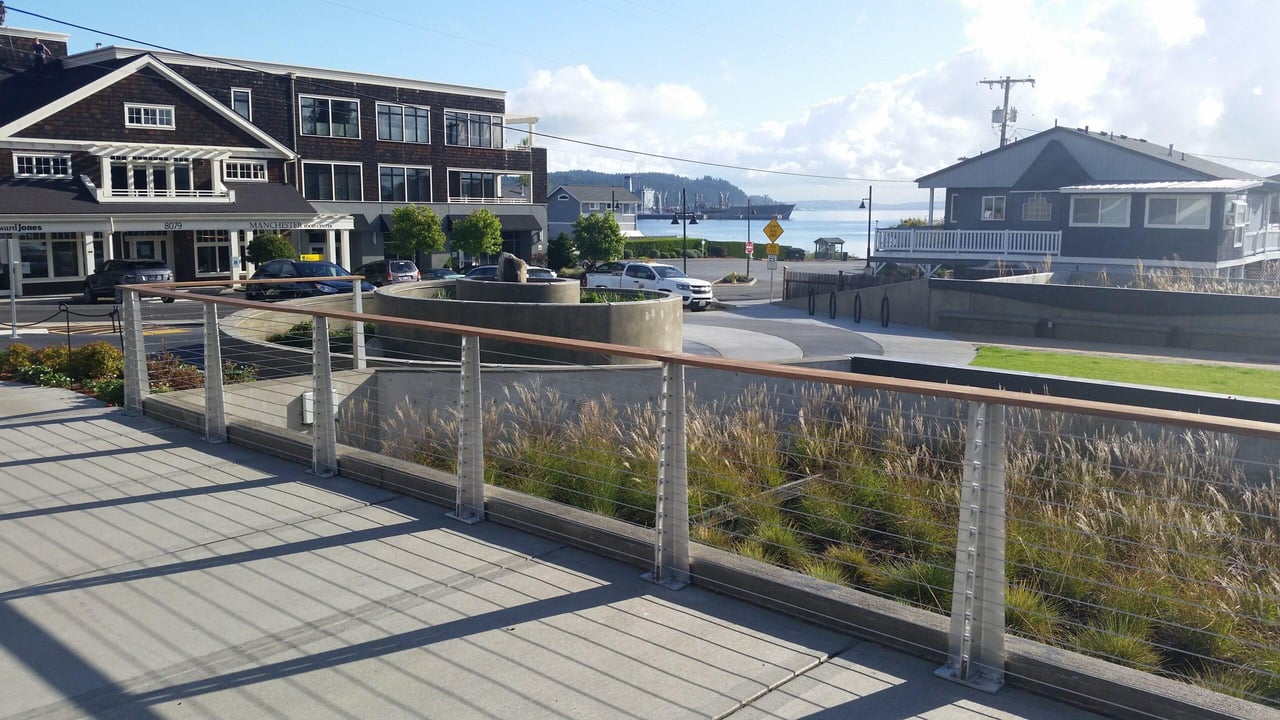
Walk out of the Manchester Library on a Saturday morning and the first thing across E Main Street looks like exactly what a small waterfront town would build for itself: a patch of green with curving paths, a spiral of plantings, and enough open lawn for a folding table or two. People sit on the grass. Kids chase each other around the rain garden. This past summer, Kitsap Regional Library used the lawn for its outdoor kids' programs, with performers setting up on Monday mornings from late June through late July. On the first weekend of August, it was hot dogs, sodas, and a flea market run by the Manchester Community Association.
What almost nobody walking through qa'qad Stormwater Park stops to think about is that the ground under their feet is working. Hard. This half-acre lot across from the library is not a park with some drainage tucked underneath it. It is a stormwater treatment plant that the county decided to also make beautiful, and understanding that order of operations changes how you see the rest of downtown Manchester.
Why the park had to exist before it could be nice
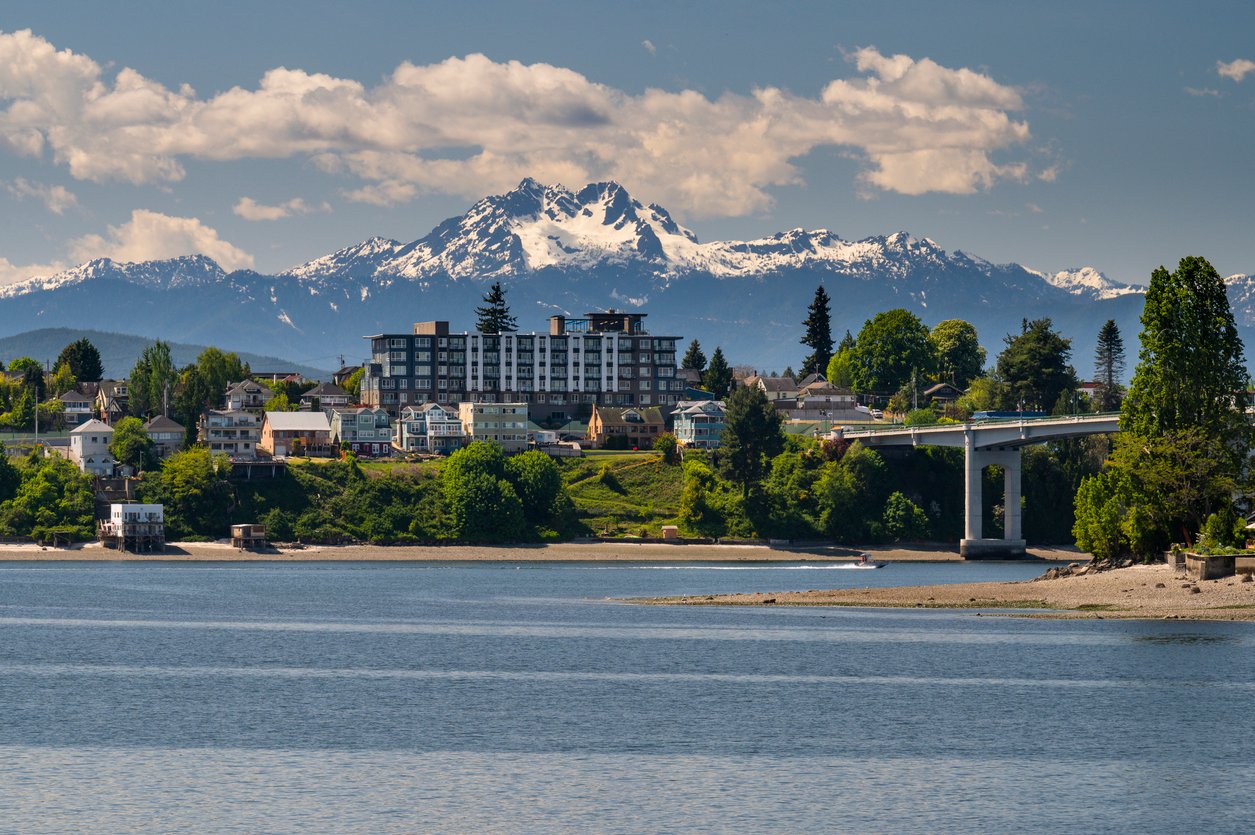
Manchester sits on an east-facing slope roughly 400 feet above Puget Sound, with its small commercial core at the bottom of that hill. For decades, that geography was the town's biggest headache. High groundwater, an undersized storm drain system, and sheet flow running straight off the roadways left downtown Manchester soggy for much of the year and prone to seasonal flooding. The runoff carried whatever it picked up along the way, road grit, oil, bacteria, straight down to the beach. By the time Kitsap County and the design firm Northwest Cascade started looking at solutions, the shoreline at the bottom of the hill had earned a reputation as one of the more polluted stretches of beach in the state.
The site they chose to fix it was an old commercial gas station lot sitting empty at the foot of the slope. Contaminated soil had to come out before anything else could go in. What replaced it is a system of four in-ground concrete treatment cells, filled with filter media and flood-tolerant plants, engineered to collect stormwater from something like 70 to 100 acres of roofs, roads, and parking lots upslope before that water ever reaches the Sound. A vertical spiral rain garden does double duty as both the park's main visual feature and part of the filtration system. According to monitoring by the University of Washington's Green Futures Lab, the design is especially effective at stripping bacteria and metals out of the runoff, and state figures put pollutant removal at roughly 91 percent before the water is released through an outfall at the beach.
That is the quiet job. The visible job, the one that gets people to actually use the space, came second and was clearly intentional. The name itself carries it: qa'qad, pronounced roughly "ka-kawd," was chosen to honor the Suquamish Tribe, whose homeland this stretch of the Kitsap Peninsula was long before Manchester had a name. Look closely at the concrete around the spiral garden wall when it's wet and there is a poem etched into it, visible only when the surface is damp, which in this climate is often. Kitsap Regional Library uses the lawn for its summer outdoor performance series. The Manchester Community Association uses it for markets and festivals. A town that could have buried its flood solution underground chose instead to put it in the most visible spot downtown and hand it back to residents as a commons.
A few things about the park are worth knowing if you plan to actually spend time in it:
- It sits directly across E Main Street from the Manchester Library at 8067 E Main Street, making the two effectively one campus even though they're run by different organizations.
- Kitsap Regional Library held its outdoor summer programs here this year, with weekly Monday morning performances running from late June through late July.
- The Manchester Community Association has used the lawn for its Summer Festival and Flea Market, along with smaller seasonal gatherings that show up on the park's calendar closer to fall and winter.
- The plantings are functional, not decorative filler. What looks like landscaping is doing filtration work every time it rains.
The library across the street has its own quiet arrangement
The building facing the park has an ownership structure that tells you something about how this town operates. Kitsap Regional Library provides the professional staff, the book collection, and the programming, but it does not own the building. The Friends of the Manchester Library own the structure itself. The Port of Manchester provides the land underneath it. Three separate organizations, none of them the county library system in the way most people assume, keeping one small branch open through a handshake that has held for decades. The original library building was a converted chicken coop before it was replaced in 1949, on land given with the stipulation that the new building be constructed on skids in case it ever needed to move.
It is the same instinct that shaped the park across the street. Nobody waited for a bigger authority to solve Manchester's problems for it. The community built its own fixes and then made sure those fixes doubled as places to gather.
Continuing the loop down to the water
From the park, the walk down to the water is short, maybe ten minutes on foot, following E Chester Road or Beach Drive E toward the shoreline. The Port of Manchester maintains the public dock here: two floating docks, a paved boat ramp, and a sandy beach that makes launching a kayak or small boat by hand straightforward. It is one of only two public docks in the immediate area, and on a warm weekend the small parking lot fills quickly.
This is also where local knowledge starts to matter more than a map. Rich Passage, the narrow channel running between the Kitsap Peninsula and Bainbridge Island right off Manchester's shore, looks calm from the beach and is not. It is one of the busier stretches of water in central Puget Sound, carrying Washington State Ferries traffic, tugs, freighters, and the occasional aircraft carrier headed to or from the naval shipyard in Bremerton, all moving through a channel with real tidal current. Paddlers who know the area well, including volunteer site stewards with the Washington Water Trails Association, are consistent on one point: do not try to cross Rich Passage in a straight line from Manchester toward Bainbridge or Blake Island. The safer route hugs the shoreline south from Manchester State Park down to the settlement itself before making a much shorter crossing away from the shipping lanes. Fog compounds the danger, since visibility to and from ferry pilots drops fast once the passage narrows near the land hook, and a loaded ferry gives paddlers very little room to react.
Two miles north of the dock, Manchester State Park stretches across 111 wooded acres with 3,400 feet of shoreline and just under two miles of trails. Its most recognizable feature, a brick torpedo warehouse built in 1901 when this land was a harbor defense installation protecting the Bremerton shipyard, now functions as a picnic shelter and an occasional wedding venue. A gun battery and a mining casemate from the same era sit nearby, remnants of a period when this quiet stretch of coastline was considered strategically important enough to arm.
Back down at the dock, the short list of places to eat covers most of what a day on the water calls for. The Manchester Pub sits just up from the pier with outdoor seating and water views, the kind of neighborhood spot where regulars are on a first-name basis with whoever's behind the bar. Carbon Mexican Steakhouse is close enough to the beach that it shows up in the same breath as the dock itself when locals describe the area to visitors.
None of this is more than a half mile from end to end. A library that isn't quite owned by the library system, a park that isn't quite just a park, a dock that requires knowing which way not to paddle, and two places to eat once you're done. That compactness is not an accident of small-town geography. It is what happens when a community keeps solving its own problems in public, one project at a time, and lets the results double as the place everyone already gathers anyway.
If you're curious about more of what makes Manchester and the surrounding Kitsap communities work the way they do, or you're weighing a move to this stretch of the peninsula down the road, Wendy Crenshaw has been walking these towns since 1998. Let's Connect.