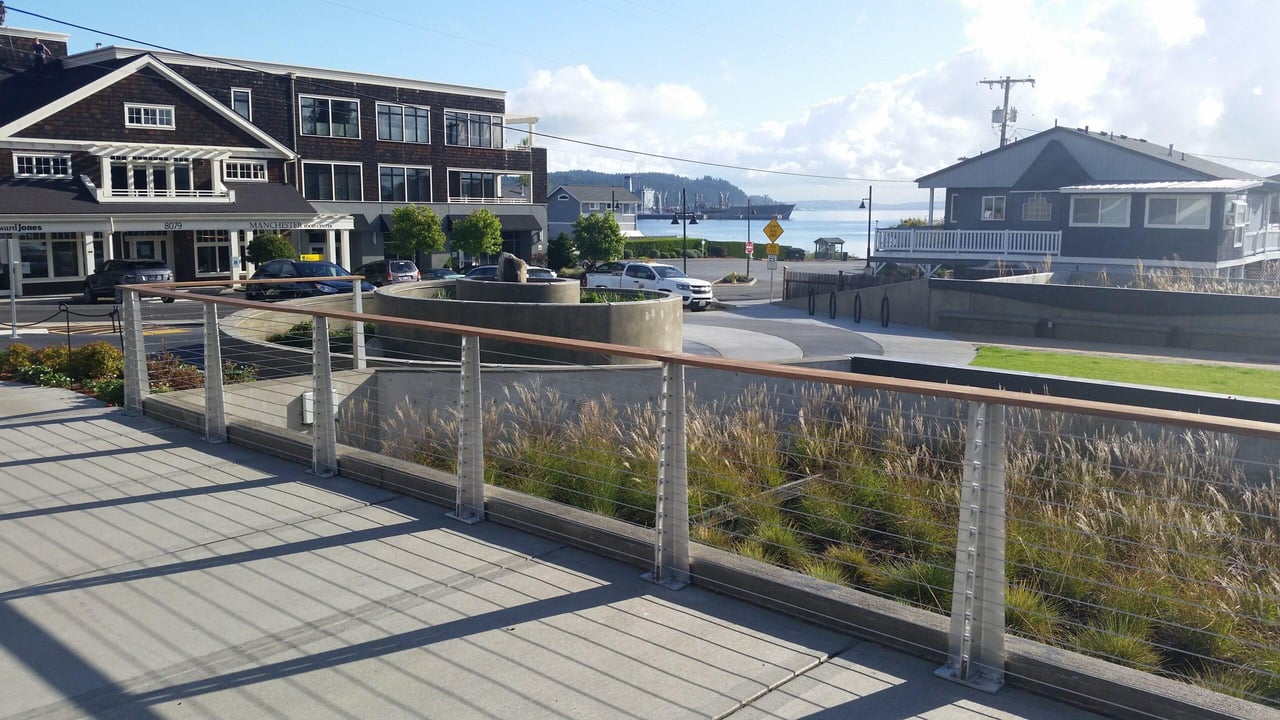
If you've started looking at homes in Manchester, you've probably already heard that a septic inspection is part of the deal. What most people don't hear until they're deep in escrow is that a septic inspection and a water report are two separate documents, filed with two different timelines, and neither one tells you anything about the other. On a shoreline lot along Sinclair Inlet or a wooded parcel back from the water, that gap is exactly where closings slow down.
This isn't a Kitsap-wide quirk. It's sharper in Manchester than almost anywhere else in the county, because Manchester is one of the few places where a home two doors down the street can be running on a completely different system than yours, and nothing about the neighborhood tells you which one you've got until someone checks.
Two systems, two forms, two agendas
The Kitsap Public Health District requires a property conveyance inspection, or PCI, on any home selling with a septic system. The inspector checks the tank, the drainfield, and the reserve area, then files a written report the seller uses to complete the septic section of the real estate disclosure form. This isn't optional paperwork. It's required under the county's Board of Health ordinance before a sale closes.
Separately, if the home runs on a private well or a small shared system known as a Group B water system, Washington has required a Water Status Report since March 2019. That report goes through the same health district but is a different application, on a different form, evaluating a different set of risks: water quality, well construction, and whether the source meets safety standards.
Both processes recommend starting the paperwork about 30 days before the property changes hands, since lab results and record reviews take time. But a seller who assumes the septic inspection covers the water supply, or the other way around, can lose that runway fast. In May 2026, half the homes that sold countywide went pending within about 9 days, and that pace hasn't left much slack anywhere in Kitsap since. A 30-day inspection clock that starts late is the kind of thing that stalls an otherwise clean transaction.
Why the map doesn't help you guess
Here's the part that trips up buyers who've done their homework elsewhere in the county. Kitsap County Public Works operates and maintains a sewer treatment plant serving Manchester, alongside similar plants in Central Kitsap, Suquamish, and Kingston. So parts of Manchester are on county sewer, billed on a flat residential rate.
But Manchester Water District, the utility that actually shows up on most homeowners' bills, provides potable water only, not sewer service, to Manchester, South Colby, Harper, and Southworth. Water and sewage are handled by two entirely different organizations here, which means being on the district's water system tells you nothing about what happens to wastewater at that address. Some homes are on the county sewer line. Others rely on a private septic system a few hundred feet away. A well can serve up to two residences before it's reclassified as a shared Group B system, subject to its own separate rules.
The practical result: you cannot infer utility status from a Manchester address, a listing photo, or how close a home sits to downtown. The only way to know is to ask, in writing, before you're committed.
What 27 percent looks like on the shoreline
The health district completed 1,743 property conveyance inspections across Kitsap County in 2025. Of those, 450, or 27 percent, turned up significant deficiencies. That's not a rare outcome. It's better than a one-in-four chance that a septic inspection finds something worth negotiating over, and Manchester's older waterfront stock adds its own layer of risk on top of that county-wide baseline.
Homes built close to Puget Sound and Sinclair Inlet sit on ground that's often saturated for good portions of the year. High water tables can create what septic professionals call hydraulic overload, where the soil is too wet to properly absorb and treat wastewater. The standard advice for shoreline properties in this stretch of Kitsap is pumping every 2 to 3 years, not the usual 3 to 5, specifically because of that saturation.
Manchester's waterfront homes tend to be older, too. Many of the shoreline properties are 1940s Cape Cods or 1970s ranch-style houses, some built on stilts to manage flood risk, while inland construction runs newer, often early-2000s Craftsman-influenced designs. Older systems on wetter ground are exactly where a PCI is most likely to land in that 27 percent.
There's a second cost that shows up alongside septic issues on waterfront lots: bulkhead condition. Where a septic report might flag a drainfield problem in the thousands of dollars, a failing bulkhead is a different scale entirely, with repair or replacement running from roughly $50,000 to more than $300,000 depending on linear footage and construction type. Buyers evaluating a Manchester waterfront home are really pricing two separate systems at once, one buried and one at the tideline, and neither shows up in a standard home inspection.
Before you write an offer, ask
A few questions save real time once you're under contract:
- Is this address on county sewer, or on a private septic system?
- If it's septic, when was the last property conveyance inspection, and is there a record drawing on file?
- Is the water supply a private well, a Group B system, or Manchester Water District service, and does it need a separate Water Status Report?
- If the lot is waterfront, is there permit history for the bulkhead, and has it had a structural look in the last several years?
None of these require a specialist to ask. They just require asking before the 30-day clock is the only thing standing between you and a closing date.
The clock that actually matters this fall
Most Kitsap closings run a matter of weeks from mutual acceptance, not months. That means the health district's recommended 30-day window for both the PCI and the Water Status Report isn't a cushion sitting on top of the timeline. It's close to the entire timeline. If either inspection application goes in on day 10 instead of day one, there may not be room left to fix a flagged problem, renegotiate, or simply wait for lab results before the scheduled closing.
For sellers listing a Manchester home this fall, ordering both inspections the same week you go under contract, not the same week you're supposed to close, is the difference between a smooth handoff and a delay nobody saw coming. For buyers, asking your agent to confirm utility status and inspection history before you write an offer means you're negotiating from information, not assumptions.
None of this changes what makes Manchester worth the extra paperwork. It's still a small, walkable waterfront community where the Manchester Library hosts its annual Salmon Bake and book sale, Manchester State Park offers camping and a historic torpedo warehouse with views toward Mount Rainier, and Main Street still has room for a place like Cups Espresso & Café and the Manchester Pub's live music nights. The systems under the ground are just part of what you're buying along with all of that.
A few questions worth asking directly
Is my home on septic or sewer if I live in Manchester? It depends on the specific address. Kitsap County Public Works operates a sewer treatment plant serving part of Manchester, while other parcels rely on private septic systems. Manchester Water District supplies drinking water to the area but does not handle sewage, so being on the water district's system doesn't answer the septic question.
Who typically handles the cost of the septic inspection? The property conveyance inspection is a seller requirement under the health district's ordinance, and it's standard for the seller to arrange and pay for it as part of preparing a home for sale.
What happens if the inspection finds a significant deficiency? The health district's report identifies the problem, which then becomes part of the real estate disclosure form. From there it's a negotiation point between buyer and seller, the same way a roof or furnace issue would be, though septic repairs on waterfront lots can run into a wider range depending on soil conditions and system type.
Manchester rewards buyers and sellers who do their homework early, and the paperwork behind a septic system or a private well is exactly the kind of detail that's easy to overlook until it isn't. If you're weighing a purchase or a sale in Manchester and want a clear read on what a specific address is dealing with, Wendy Crenshaw has spent years walking Kitsap buyers and sellers through exactly this kind of local detail. Let's Connect.